Screw Preload as a Biomechanical Determinant of Implant Stability
In two-piece implant systems, mechanical stability is shaped by the interaction of connection geometry and screw mechanics; it cannot be inferred from the nominal insertion torque alone. A primary determinant is screw preload, because it establishes the clamping force across the implant–abutment interface and defines whether the assembly behaves as a unified load-bearing structure or as a joint prone to micromovement, microgap formation, and fatigue. Importantly, the relative weight of these factors is connection-specific: in internal hex designs, stability depends predominantly on maintaining adequate preload to control joint separation and micro-mobility, whereas in conical (Morse taper) connections the conical interface can contribute additional frictional locking and resistance to micromovement—provided the components are fully seated and sufficient preload (and therefore clamping force) is achieved. In clinical implant dentistry, screw loosening is often treated as a minor technical inconvenience. From a biomechanical standpoint, however, it is typically the clinical endpoint of progressive preload loss and a reduction in clamping force over time, driven by mechanisms such as embedment relaxation and functional loading. Understanding how preload is generated, maintained, and lost is therefore not optional—it is central to controlling implant stability, minimizing mechanical complications, and helping preserve peri-implant bone.
Definition of Screw Preload
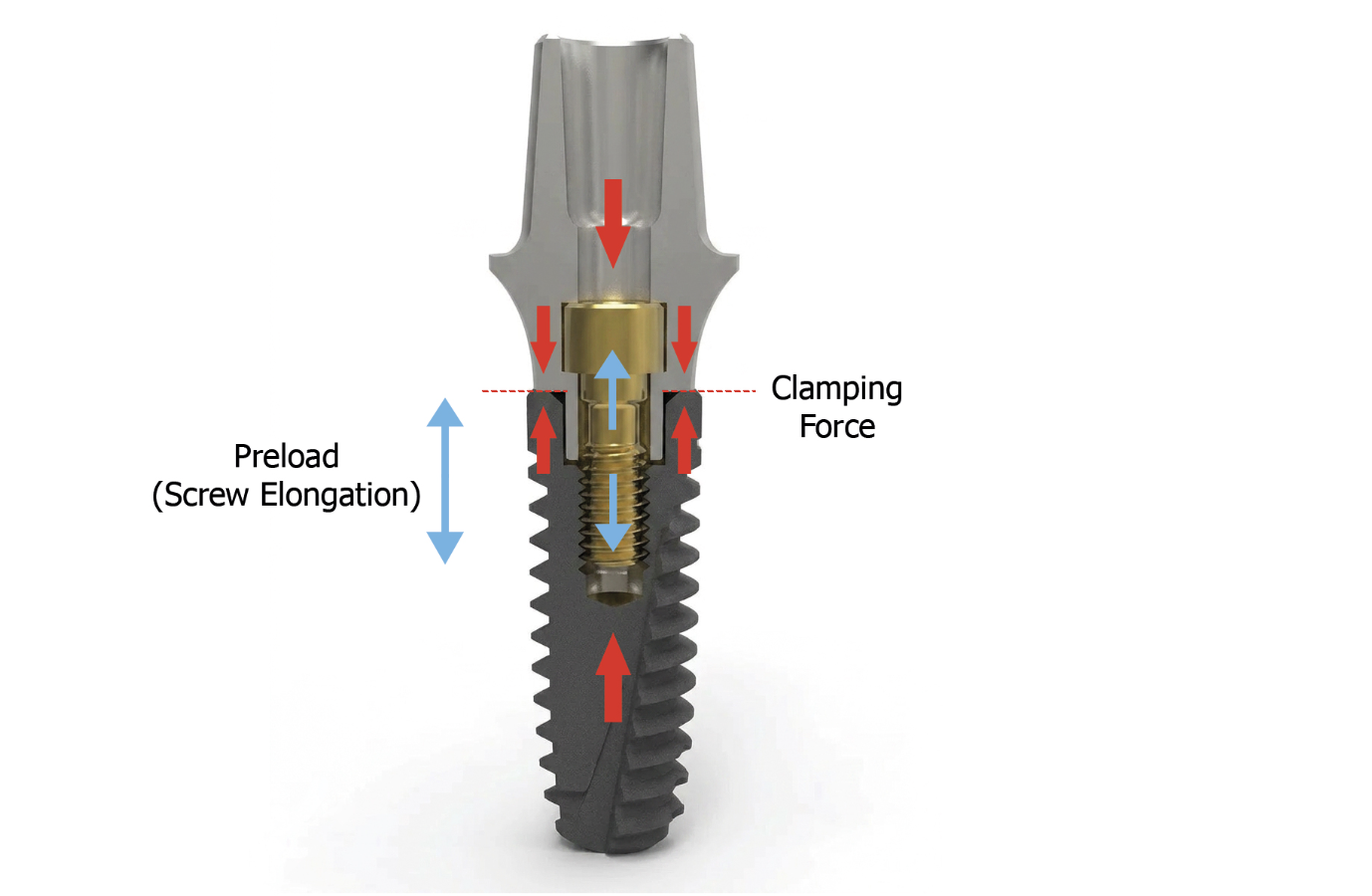
Screw preload is the tensile force generated within an abutment screw when tightening torque induces elastic elongation. As torque is applied, the screw stretches microscopically within its elastic limit. This elongation produces a compressive clamping force between the implant and the abutment. That clamping force—rather than the screw shank acting as a “structural pin”—is what stabilizes the joint and maintains intimate contact at the interface. In a properly preloaded implant–abutment connection, functional loads are transmitted primarily across the compressed interface through friction and surface contact. The screw’s biomechanical role is therefore to maintain compression; depending on the relative stiffness of the screw and the joint, only a portion of external loading is transferred into additional screw tension, while the remainder is borne by the clamped components. During mastication, occlusal loading is multi-directional. What matters mechanically is the separating component of that load and how it interacts with the joint’s stiffness. If the separating component is sufficiently high—and/or if preload has diminished due to embedment relaxation or cyclic loading—the clamping force can be locally overcome, allowing microscopic interface opening during load peaks. Once micro-opening occurs, micromovement and fretting can accelerate preload loss and increase the risk of screw loosening and fatigue. Preload, therefore, defines whether an implant restoration functions as a stable mechanical assembly or as a joint that intermittently opens under cyclic loading.
Torque vs Preload: A Non-Equivalent Relationship
Clinically, torque is measurable and can be standardized. Preload, however, is not directly measured chairside. This gap has contributed to a common—but incomplete—assumption that “torque equals stability.” Torque is a rotational input (N·cm). Preload is the resulting axial tensile force created when that torque produces elastic screw elongation. The relationship is indirect and strongly influenced by friction. From an engineering perspective, tightening torque is an inefficient way to generate preload: only a small fraction contributes to screw stretch, while most is dissipated overcoming friction at the threads and under the screw head. As a result, two abutment screws tightened to the same torque can develop substantially different preload values. Consequently, identical torque protocols across implant systems do not guarantee equivalent clamping force or comparable mechanical behavior at the implant–abutment interface. In implant biomechanics, preload is the primary controllable variable clinicians apply chairside, but resistance to joint micro-opening and separation is ultimately determined by preload in combination with connection design (butt-joint vs conical), joint stiffness (implant/abutment geometry), interface friction, and the magnitude and direction of functional loading (including bending moments). 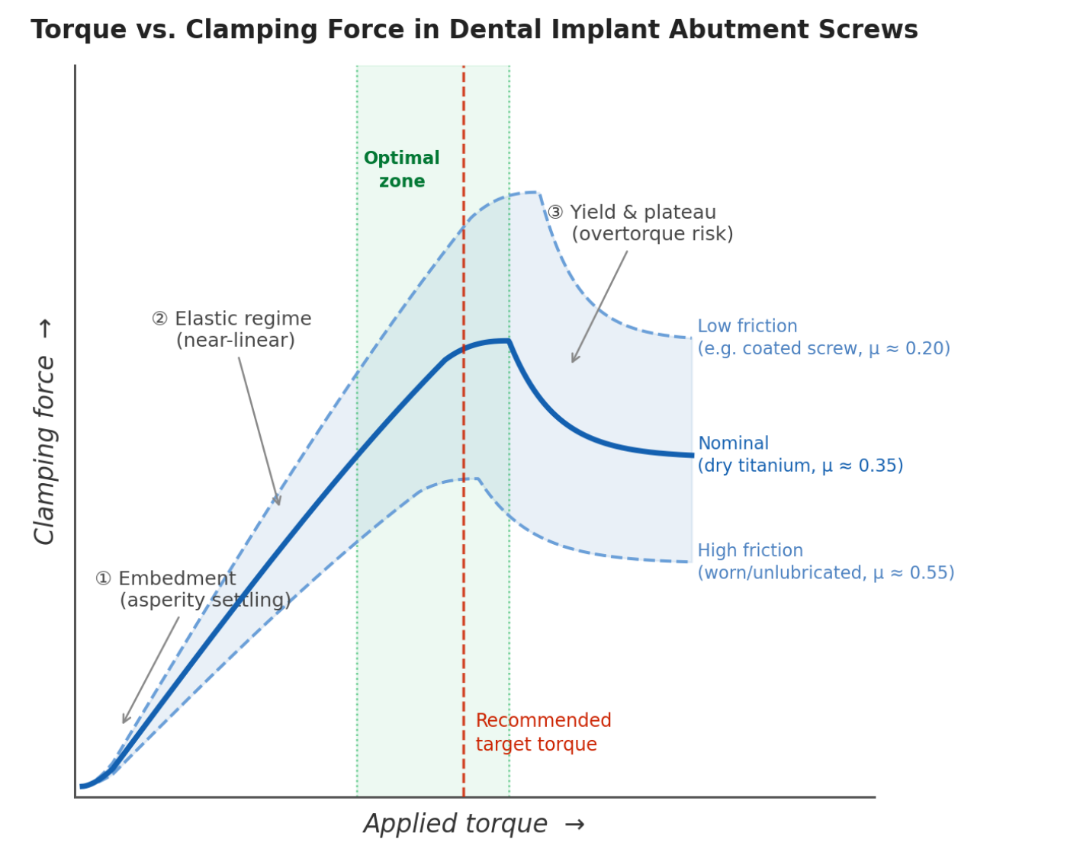
Why Most Applied Torque Is Lost to Friction
During screw tightening, friction dominates energy distribution. Mechanical analyses commonly cite that a large share of applied torque—often reported in the range of ~80–90%—is dissipated overcoming frictional resistance, while a smaller fraction—typically ~10–20%—is converted into useful elastic elongation (preload). These values should be understood as representative ranges rather than universal constants, and the exact proportion depends on the specific screw–joint system. Friction arises at two principal interfaces: thread-to-thread contact and the bearing surface beneath the screw head. Microscopic asperities at these interfaces generate resistance that absorbs rotational energy before meaningful axial tensile force develops within the screw shaft. In practical terms, small changes in surface condition can shift how efficiently torque is translated into preload. This frictional dependency explains several clinical observations: Increasing torque does not proportionally increase preload. Surface modifications can significantly alter joint behavior. Variability in screw manufacturing influences mechanical outcomes. Because preload generation is friction-limited, the coefficient of friction becomes a decisive variable in the achieved clamping force and, ultimately, implant–abutment joint stability. Influence of Screw Material and Surface Engineering 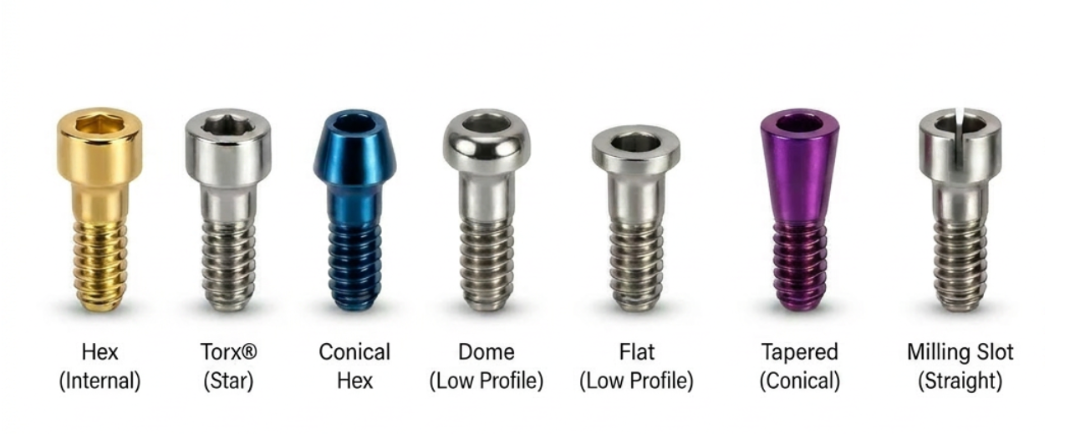 Abutment screw performance is strongly influenced by material properties and surface engineering. Titanium alloy screws generally demonstrate higher yield strength than commercially pure titanium, allowing greater elastic elongation before plastic deformation. This can increase the attainable preload range within limits set by both the screw and the implant’s internal threads—including constraints related to thread stripping risk, implant internal thread strength, screw-head and driver interface geometry, and friction variability. Surface treatments—including gold coatings, lubricated interfaces, and advanced low-friction coatings—can reduce the coefficient of friction and improve torque-to-preload conversion efficiency. Lower friction allows a larger proportion of applied torque to generate tensile force (preload) rather than being dissipated, which can improve preload predictability and, in some cases, permit higher achievable preload at a given torque protocol. Precision machining and engineering also affect both preload efficiency and the achievable preload ceiling. Thread geometry, surface roughness, and tolerance control influence how consistently the mating surfaces seat, how friction behaves at the threads and under the screw head, and how reliably torque is translated into clamping force without exceeding the mechanical limits of the screw or the implant’s internal threads. For clinicians selecting implant systems, understanding these variables is essential. Nominal torque values alone do not define mechanical reliability; abutment screw mechanics and material science directly influence long-term implant stability.
Embedment Relaxation (Settling Effect) and Early Preload Loss
Even when optimal preload is achieved, it does not remain constant. Embedment relaxation — commonly referred to as the settling effect — is an inherent phenomenon in all screw joints. No contacting surfaces are perfectly smooth. Upon tightening, only the microscopic high points initially contact each other. Under compressive load, these asperities plastically deform and flatten. As surfaces adapt, the components move closer together. This movement reduces screw elongation and, consequently, reduces preload. Experimental data in implant biomechanics demonstrate that measurable preload loss can occur within minutes of initial tightening — even before functional loading begins. Additional preload reduction occurs under cyclic occlusal forces. Importantly, embedment relaxation is not a failure event. It is a predictable mechanical process that must be managed clinically. 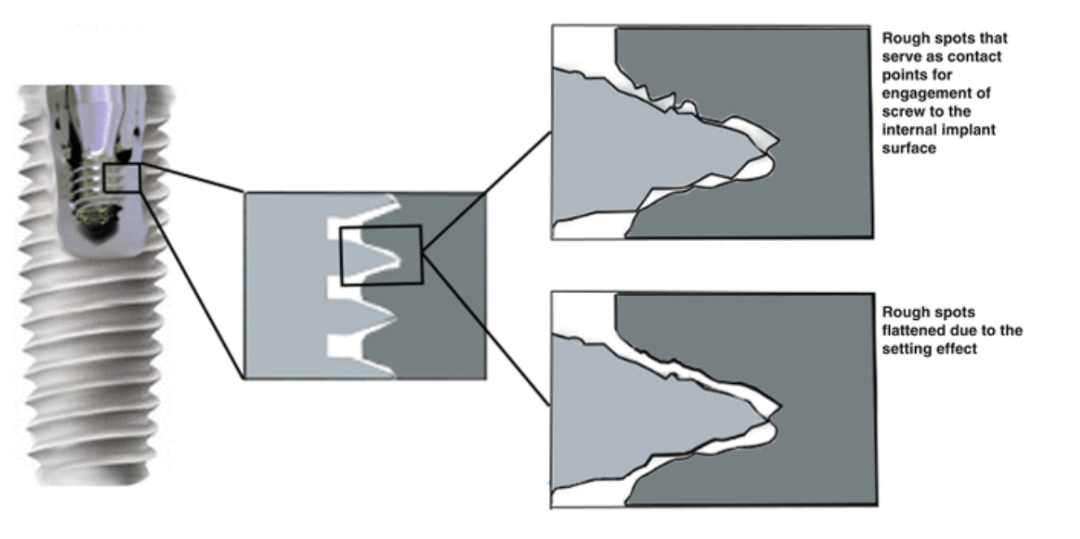
Biomechanical Rationale for Retightening Protocols
Because early preload loss is inherent to bolted joints, retightening protocols are mechanically justified rather than empirically convenient. Allowing a short interval after initial torque application permits primary settling (embedment relaxation) to occur. Reapplying the manufacturer-recommended torque helps restore elastic elongation and re-establish the intended clamping force. When performed with new, undamaged components and within manufacturer torque recommendations, retightening is generally considered safe and serves to compensate for early preload loss following settling. Its purpose is not to increase torque beyond specified limits, but to recover clamping force that was reduced during initial interface adaptation. In preload-dependent implant connections—particularly those with limited geometric interlocking-failure to retighten reduces the mechanical safety margin against screw loosening. For this reason, many protocols recommend retightening after a short interval following initial tightening, in accordance with manufacturer guidance.
Clinical Consequences of Progressive Preload Loss
When preload decreases to a level at which the separating component of functional load is no longer adequately counteracted, the implant–abutment interface may open microscopically during mastication cycles. Such separation can be transient and minimal, but under certain conditions it may become recurrent. If micro-opening becomes repetitive, frictional stabilization is intermittently reduced and the screw is subjected to higher cyclic tensile stresses, potentially combined with bending moments depending on load direction and prosthetic design. Over time, this may increase the risk of rotational loosening and progressive micromovement. In more severe mechanical scenarios—such as parafunctional loading, cantilevered restorations, or unfavorable load distribution—elevated cyclic stresses can contribute to fatigue-related complications. Screw loosening, therefore, should not be viewed as the initiating event. Rather, it is often a clinical manifestation of insufficient or progressively reduced preload in combination with functional loading conditions and connection design. Biologically, repetitive micro-movement and microgap dynamics may promote fluid and bacterial migration at the implant–abutment interface, which has been associated with inflammatory challenges at the crestal region. From a mechanical standpoint, ongoing preload reduction can contribute to interface wear and reduced long-term reliability, depending on system design and loading environment. Thus, preload loss is not merely a mechanical inconvenience—it represents a significant risk modifier in both mechanical and biological complications associated with implant restorations, particularly when compounded by adverse loading or design factors.
Preload as the Hidden Control Variable in Implant Biomechanics
All two-piece implant systems benefit from adequate preload, but the degree of dependence varies by connection design. Butt-joint configurations—such as external and many internal hex systems—rely heavily on screw-generated clamping force to maintain joint integrity. In contrast, conical (Morse taper) connections gain additional mechanical stability from frictional locking and radial compression at the interface, reducing—but not eliminating—their dependence on screw preload. 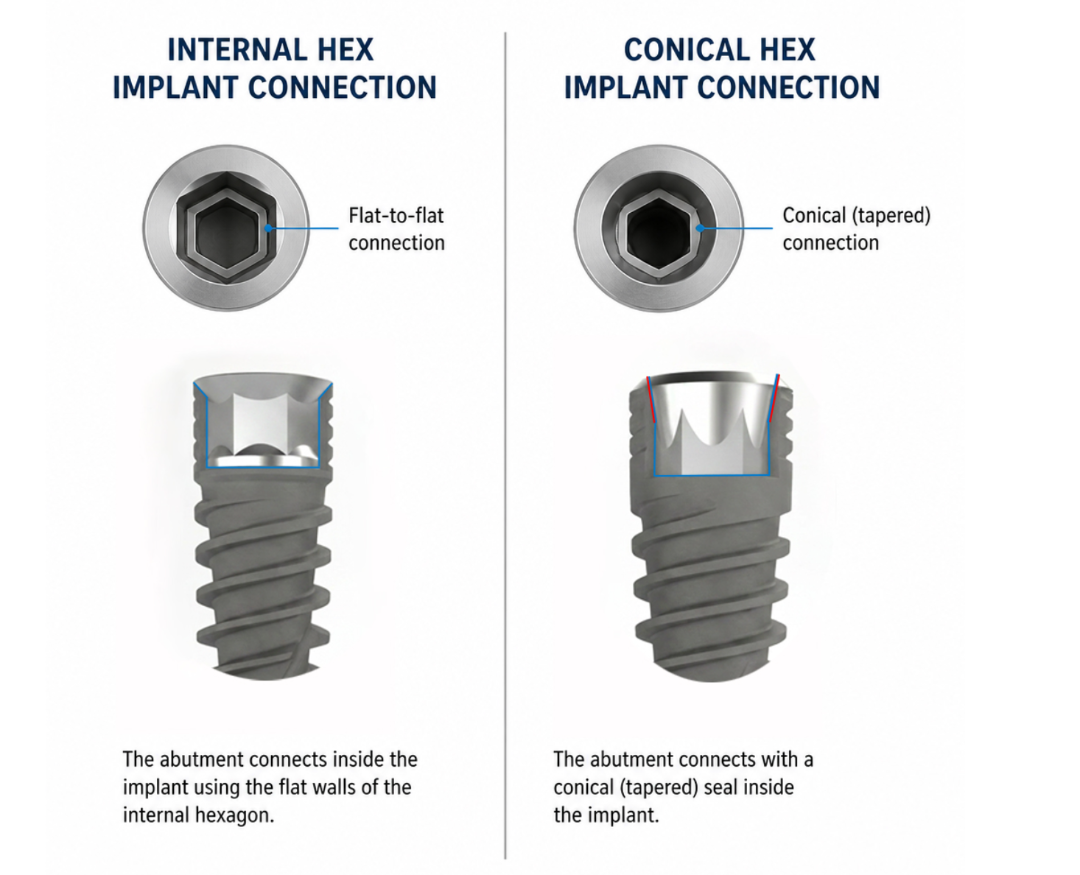 Connection geometry may therefore provide varying degrees of mechanical redundancy. However, when the separating component of functional load exceeds the combined stabilizing mechanisms of the joint—whether clamping force alone or clamping force plus conical friction—micro-opening and mechanical instability can occur. The clinically relevant question is not whether preload will decrease; some early reduction is expected due to settling and functional loading. The decisive question is how much mechanical margin remains once preload begins to erode, and how connection design influences that margin. Understanding screw preload reframes implant stability as a controlled biomechanical relationship between clamping force, connection geometry, and functional load. It explains why some systems tolerate cyclic stress more predictably, why retightening protocols can be relevant, and why torque alone cannot be equated with security. For implantologists and restorative clinicians, mastery of preload mechanics transforms screw tightening from a procedural step into a controlled stability strategy. In contemporary implant dentistry, screw preload is not merely a secondary technical parameter. It is a central, clinician-influenced variable that—together with connection design and loading conditions—determines whether implant stability is preserved or progressively compromised.
Engineering Stability in Practice: Clinical Takeaways
Implant–abutment stability is not determined by a single design feature. Performance is shaped by how connection design, material properties, and surface engineering work together to generate and preserve clamping forces while minimizing micromovement under functional load. For clinicians managing high-demand restorative cases—full-arch reconstructions, immediate loading, or posterior high-load zones—the mechanical safety margin becomes clinically relevant. In such scenarios, limited preload reserve combined with unfavorable load direction, cantilever effects, or parafunction may increase the likelihood of mechanical complications. From a practical standpoint, maintaining healthy preload involves: Applying torque strictly according to manufacturer recommendations Using new, undamaged screws when indicated Allowing short settling intervals before retightening (per manufacturer guidance) Understanding how connection design (butt-joint vs conical) influences dependence on clamping force Considering load direction, prosthetic design, and cantilever effects in treatment planning Of these variables, preload is the one clinicians can most directly influence chairside. Managing it well is not about tightening harder—it's about understanding how torque, friction, connection geometry, joint stiffness, material behavior, and functional loading interact. When these factors are respected, implant stability becomes predictable not by chance, but by controlled mechanical principles.